It is 2am. I am staring at four windows running in parallel on my screen. One is processing client materials. One is fixing code. One is catching up on unread Slack messages. The fourth is stuck on an API rate limit, waiting for me to make a call. I am not using AI. I am managing AI — like a factory foreman doing rounds at two in the morning.
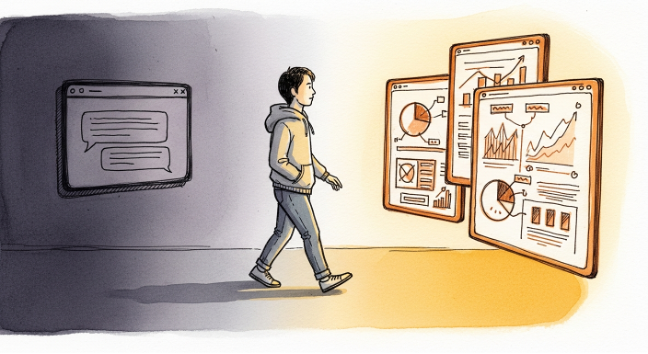
Two months ago, I thought I had hit the ceiling of what AI could do for me. I had used it daily since GPT-3.5 — two years of conversation, a smarter sounding board, nothing more. Then the chatting stopped and the managing started. The chasm between those two modes — chatting with AI versus actually working with it — turned out to be the most important professional crossing I have ever made. This is a field report from the other side, including the failures.
The Ceiling I Built for Myself
I am not a bystander to AI. I run a company that has fully embraced it. I have written Python, worked with APIs, followed the research. I was using it multiple times a day — drafting memos, pressure-testing strategy, preparing for meetings.
That comfort was exactly the trap.
Because what I was doing — all of it — was chatting. Open a tab, ask a question, get an answer, close the tab. Start fresh next time. I used AI the way most executives use it: as a smart assistant you talk to, not a colleague you work with. I tried packaged agent products along the way. Manus could hold a brief and track context across sessions — useful for presentations, but the interaction was still: I instruct, it executes, one step at a time.
I knew about coding copilots — GitHub Copilot and the like. But I am a CEO, not an engineer. I had written enough code to be dangerous, not enough to be productive. The idea of sitting in an IDE felt like going backwards in my career. I had unconsciously sorted tools into categories: this is for programmers, that is for managers. That ceiling was not imposed by the tools. I built it myself. I had decided what was “for someone like me” and stopped looking beyond it.
What It Feels Like When the Wall Comes Down
Our CTO pushed me to try Cursor. An IDE — a programmer’s tool. I had not coded seriously in years. But curiosity won.
Cursor does not care what your job title is. You describe what you want in plain English, and it builds — not autocomplete, construction. For someone who had always been one step removed from implementation, able to spec things but never build them, it felt like a wall coming down. I could touch the implementation layer for the first time.
Then he pushed me toward Claude Code — Anthropic’s command-line AI agent — and something broke open.
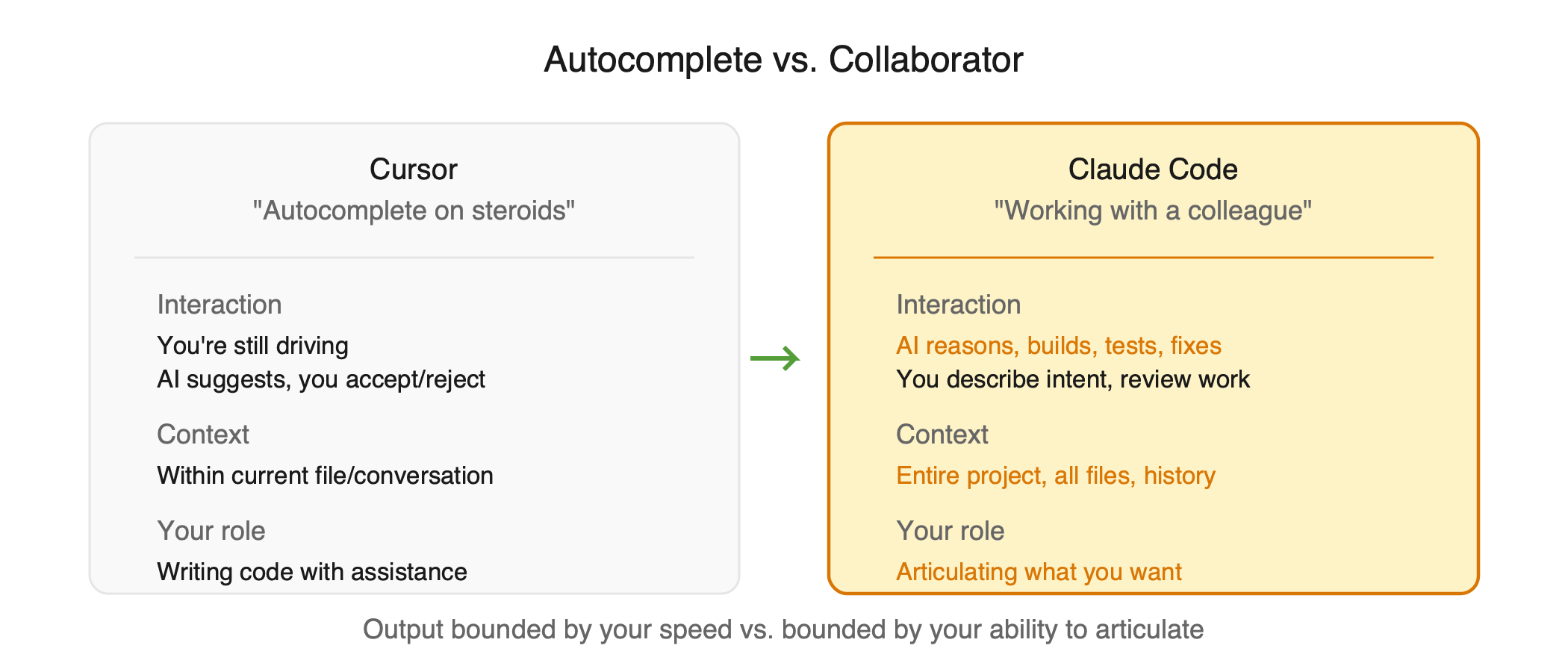
Cursor is a smart copilot — you are still driving, line by line. Claude Code is a colleague. I describe the goal. It reasons through the problem, asks clarifying questions, writes the code, tests it, fixes what breaks. It holds the entire project in its head — which files exist, how they connect, what we built yesterday. My role shifted from writing to reviewing. The bottleneck moved from my technical ability to two entirely different things: how clearly I can articulate what I want, and how well I can judge what comes back.
Those two skills, it turns out, are CEO skills. I had been telling myself coding tools were not for me. What I had not realized is that the tools had moved to where I already was.
Then I discovered OpenClaw — an open-source multi-agent framework — and the floor dropped out again.
Manus to Cursor to Claude Code to OpenClaw. The whole progression took about three to four weeks, an acceleration curve: each jump faster and deeper than the last. By the end I was no longer using a single AI tool. I was running a system.
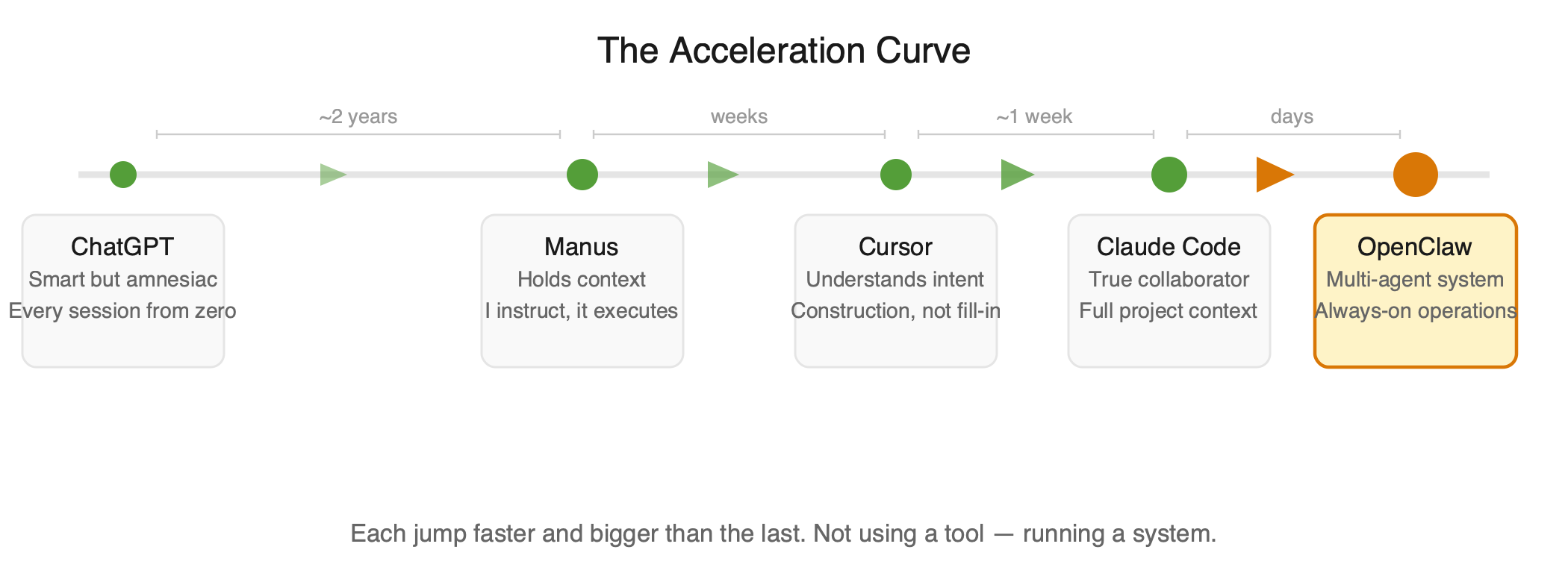
The acceleration curve: each jump faster and deeper than the last
The Other Side
Here is what the other side of that chasm looks like — this will probably look different in a month:
I run two layers. OpenClaw is the always-on layer. It sits on a cloud server, monitors our company Slack, and handles the operational rhythm of running a business: digesting team updates, executing outreach workflows, tracking client requests, nudging the team on deadlines. Clawing together the pieces scattered across people, tools, and channels that no one had time to connect before.
Claude Code is the deep-focus layer. When I need to think hard about one thing — write this article, architect a new workflow, debug OpenClaw itself — I sit in Claude Code. OpenClaw is the factory floor; Claude Code is the workbench.
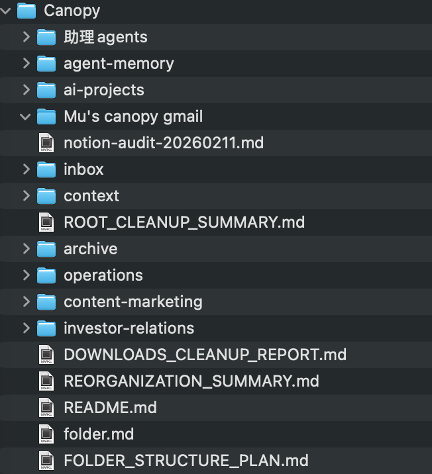
Restructured for agents: markdown files serve as briefing documents so AI understands the project
The split matters because different AI tools have genuinely different strengths — different models, different memory, different levels of autonomy. Figuring out which agent to assign which task is itself a new kind of work, and I am still learning. But the point is not the specific tools. The point is that I crossed from asking AI questions to running AI systems — and the difference is not incremental. It is structural.
What It Actually Feels Like
Here is what changed:
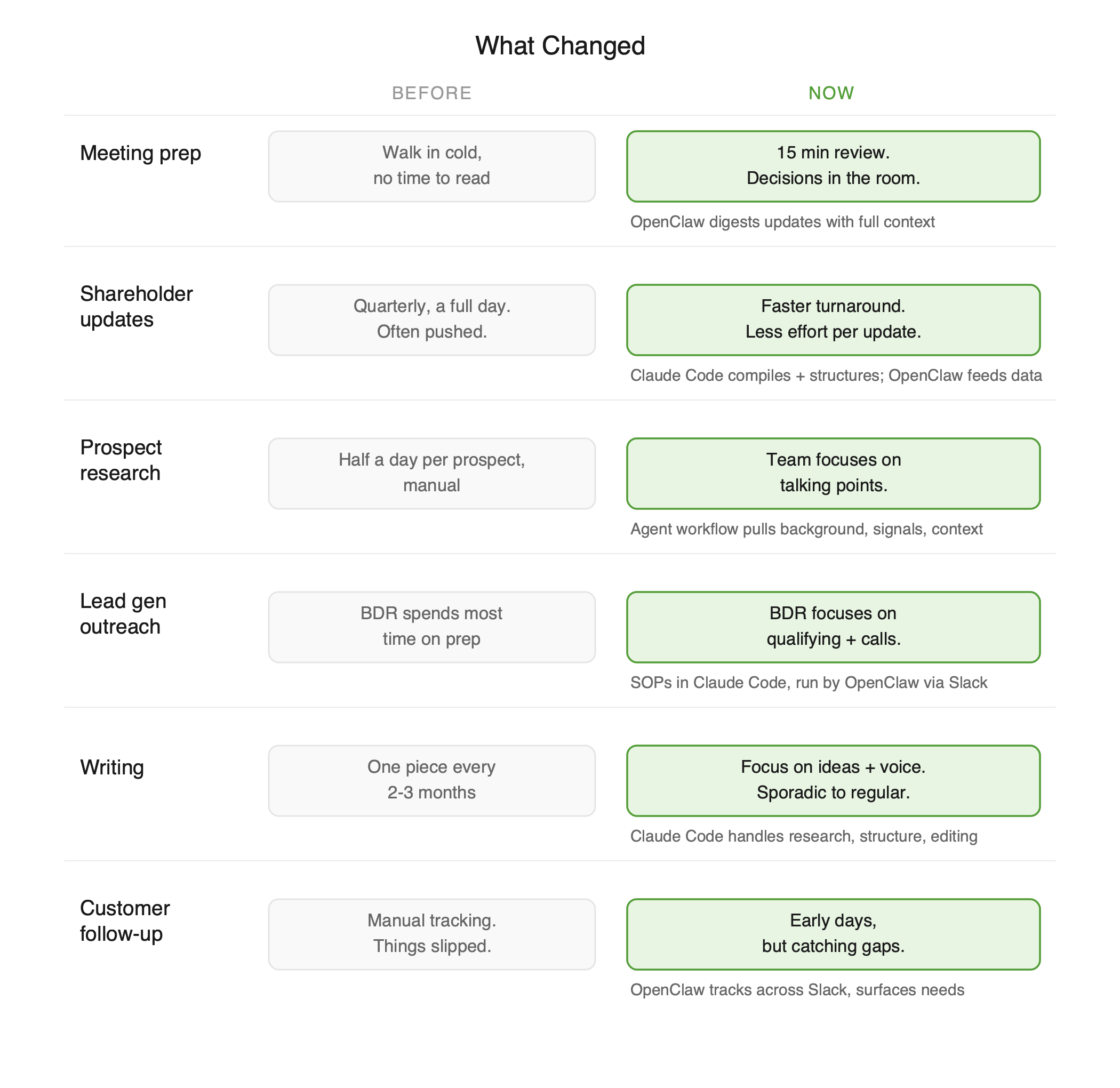
Before and after: concrete changes across six areas of CEO work
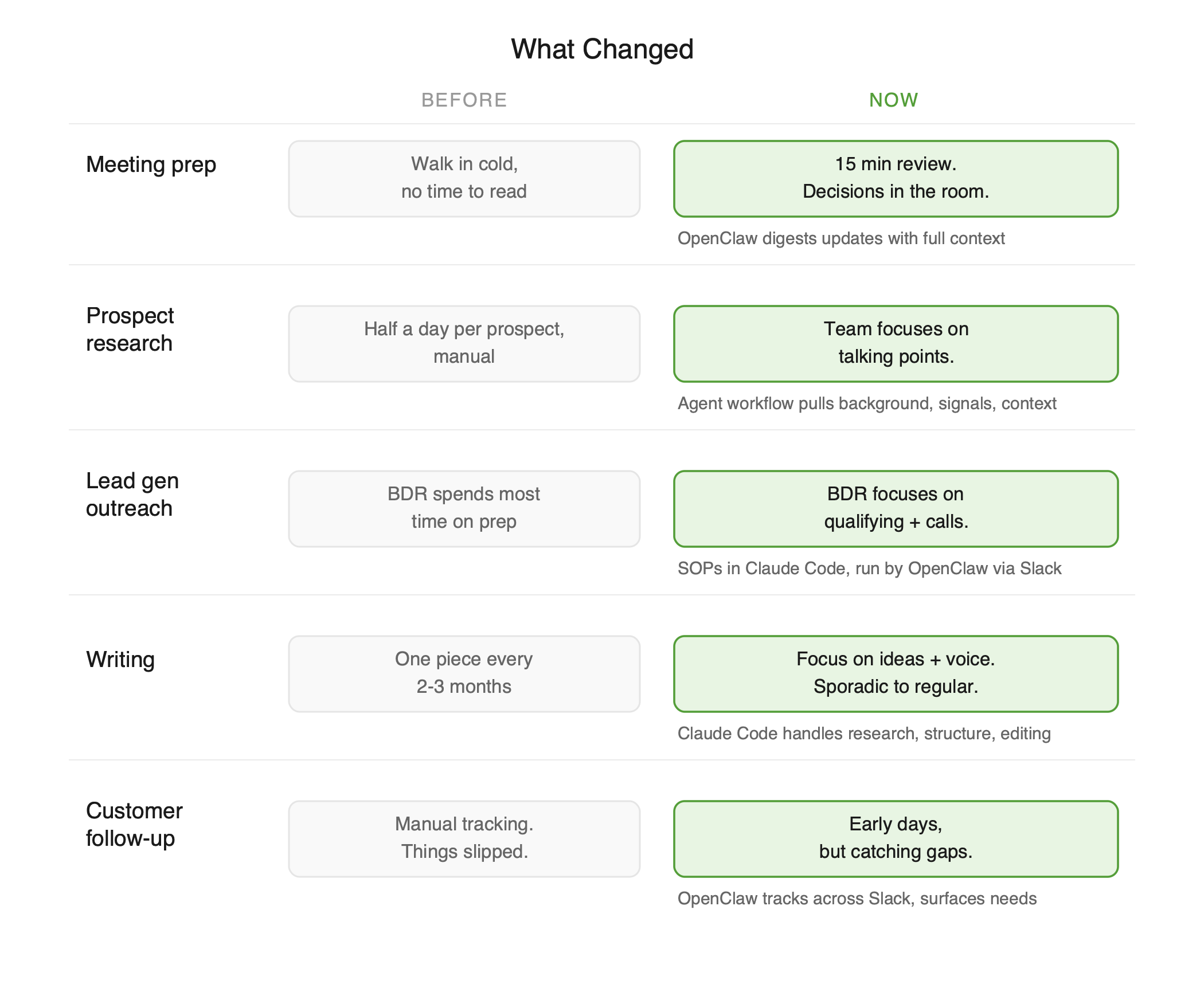
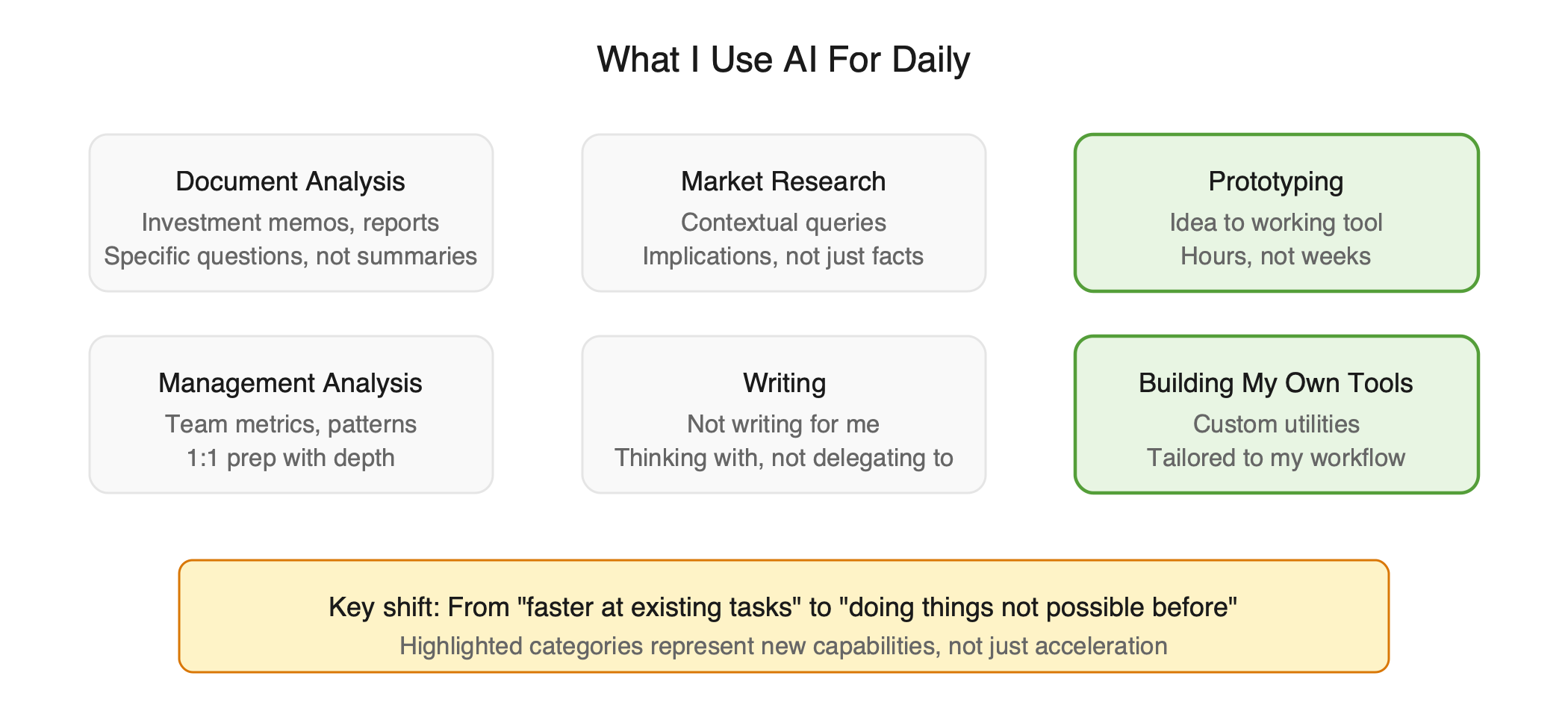
The time savings are real — tasks that used to take one to two weeks now take an hour. But speed is not the main point. As a CEO, there is always more to do than you have bandwidth for. Many tasks sit in an awkward middle ground: worth doing, but not big enough to justify a hire. So they simply do not get done — the shareholder update gets pushed, the prospect research stays shallow, the follow-up slips. AI did not just make my existing work faster. It made the work that was falling through the cracks actually happen.
And crossing the chasm opened a door I did not expect: to AI itself. I use voice chat with AI on walks, in taxis, between meetings — an idea I mention while crossing the street turns into a spec by the time I sit down. By working with agents daily, I am hands-on with the frontier — switching between foundation models (Claude, Gemini, Qwen, Kimi), building RAG pipelines, wrestling with agent memory systems. Not reading about them. Using them. The anxiety about falling behind in AI — the feeling every executive carries right now — is gone. Not because I know everything, but because I have a setup that lets me touch everything.
What does this mean if you run a family office?
You are not managing code. You are managing multi-generational wealth, complex family dynamics, and regulatory-sensitive data. Your caution toward automation is justified — one wrong instruction could affect asset arrangements across generations, one data breach could destroy a family’s reputation. But caution is not the same as avoidance.
The core work of a family office is, at its root: gather fragmented information, synthesize understanding, make a judgment, execute, verify. From consolidating positions across custodian banks, to forecasting PE fund cash flows, to customizing reports for each family member — how much of that is repetitive data assembly, and how much is actual decision-making?
AI will not make your asset allocation decisions or tell you which fund manager to trust. But it can give you a complete cross-custodian portfolio view fifteen minutes before a meeting, and flag the key clauses and risk factors buried in due diligence materials before you have finished your coffee. The line that matters is between information processing that can be automated and judgment that must stay human. Once you draw that line clearly, the flywheel starts — and the gap between those who have crossed and those who have not widens fast.
The Part Nobody Warns You About
That was the rosy version. Here is the rest.
The setup eats you alive. The tasks I described take less time now. But building and maintaining the system that makes them faster is a new, ongoing job. I traded task time for infrastructure time — and for me, the net is clearly positive. But I have the motivation, the technical background, and the hours to burn. For most people, it would not be.
The world is not built for agents. CAPTCHAs, two-factor prompts, session timeouts, PDFs, legacy spreadsheets, API rate limits designed for human-speed usage — every time an agent hits one of these walls, you are the one who finds the workaround. (This friction is also an enormous opportunity — including for companies like ours. Barriers are business models.) And self-built agents are not products. They are LEGO — memory, reporting, task orchestration, permissions, monitoring, error handling, tool integrations — each block requiring decisions, many requiring technical judgment. It never finishes, because the underlying models, APIs, and tools shift every few weeks.
Even though the latest agents understand plain English, you still need to guide and override them when their reasoning goes sideways.
I recently set out to build a three-layer memory system for OpenClaw: real-time memory, daily memory, weekly memory. Sounds clean, right? I had Claude Code read a stack of research papers and design the architecture. It produced a plan that looked thorough and complete. I exhaled, thinking this was done.
It would not run.
I had a second Claude instance review the architecture. It found structural problems. I fixed them. It broke again. I opened Codex — OpenAI’s coding agent — for a fresh pair of eyes. It spotted new edge cases I had missed. Fixed those. Then OpenClaw shipped a new version that overwrote the code I had been modifying for days. Back to square one.
The most absurd part: Claude and Codex sometimes introduced typos — not reasoning errors, just misspellings in the instructions they wrote for themselves. These trivial mistakes doubled the time I spent hunting for problems, because you always assume something fundamental is broken, and you spend hours looking at the big picture before discovering that one word is missing a letter.
Four or five days of this loop: fix, break, fix, break — the feeling of running in place. In the end, I had to pull out the critical sections and review them line by line, manually. This was about as far from “saving time with AI” as I could get.
The memory system works now, maybe eighty to ninety percent of the time. Real-time memory still throws errors occasionally, but at least the agents have logged enough of their own fix history that I can trace what went wrong. Are there still bugs? Yes. Am I reasonably confident the three layers are holding? Mostly. Fingers crossed.
The tools have never been more accessible. The judgment required to use them well has never been more scarce.
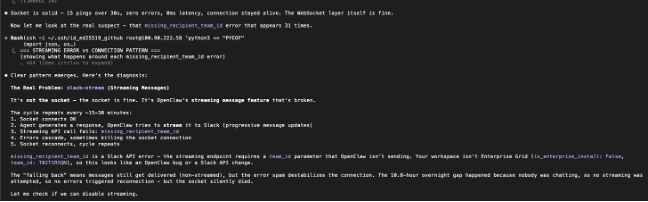
Claude Code in action — what “working with AI” actually looks like
Then there is what it does to you. For about two weeks, I was genuinely suffocating. Agents constantly requesting permissions, asking for decisions, producing output faster than I could review. I worked until 2-3am every night — not because I had to, but because I could not stop. I started calling it the human token rate limit: the bottleneck in the system is no longer the machine. It is you.
And it hooks you. Researchers have found that the non-deterministic nature of AI responses triggers dopamine pathways similar to slot machines — variable rewards that keep you reaching for the next hit. An HBR study this month confirmed the pattern: “AI tools didn’t reduce work — they consistently intensified it.”

There is a scene in The Matrix where Neo wakes up and realizes he has been plugged into a system, generating output he thought was his own life. The parallel is not exact, but the feeling is uncomfortably familiar. My counselor put it more simply: “You told me AI was supposed to free up your time. Why are you more stressed than before?”
I suspect this is one of the existential questions of the AI wave — not whether the technology works, but what it does to the people who use it best. It is bigger than my personal experience. I am still figuring out how to live inside this. If you go down this path, you will need to figure it out too.
If You Are Starting Now
If you sense there is more to AI than what you are getting out of it, you are right. What I did not realize is that AI has been closing the distance from its side — the tools have gotten so much better, so fast, that you might be one step away from a qualitative shift and not know it. Pick one task you actually care about. Give AI real context. Let trust build from there. The doubt will not go away — it just changes shape — and the learning tax keeps being collected. But the returns are real.
The line between chatting with AI and working with AI is widening. Angelo Robles, who has worked with over a hundred billionaire families, put it bluntly: “What used to require twenty employees now requires one or two people with AI.” I crossed two months ago. It was messy, exhausting, and unfinished — I nearly burned myself out. I am not writing this from the mountaintop. I am writing from halfway up the climb, out of breath.
But I would not go back.
In the next few pieces, I will go deeper — hard data on AI agents, how my team uses these tools day to day, and how we are rethinking Canopy’s product at the intersection of AI and wealth management. But if there is one thing to take from this piece: the chasm is crossable. It starts with one task.
Mu Chen is the CEO of Canopy, which serves 60+ family offices and UHNW clients globally, tracking over USD 90 billion in assets. He is also a guest lecturer at Tsinghua PBCSF. He writes about the frontline intersection of AI and wealth management at Amongst Families.
[1] M. Karen Shen & Dongwook Yoon, “The Dark Addiction Patterns of Current AI Chatbot Interfaces”, CHI 2025
[2] Aruna Ranganathan & Xingqi Maggie Ye, “AI Doesn’t Reduce Work — It Intensifies It”, Harvard Business Review, February 2026
[3] Angelo Robles, Family Office Association